The Problem
Take a 10-second 16 kHz clip. That is 160,000 floats, all in [-1, 1], almost perfectly uncorrelated with the label "dog barking" or "the word cat". The raw waveform has the information but in a form the model cannot easily extract. Two identical phonemes spoken 100 ms apart have completely different raw samples.
A spectrogram fixes this. It collapses the temporal detail where human perception ignores it (microsecond jitter) and preserves the structure where perception attends (which frequencies are energetic, over time windows of ~10–25 ms).
Mel spectrograms push further. Humans perceive pitch logarithmically: 100 Hz vs 200 Hz sounds "the same distance apart" as 1000 Hz vs 2000 Hz. The mel scale warps the frequency axis to match. A mel-scaled spectrogram is the single most important feature in speech ML from 2010 through 2026.
The Concept
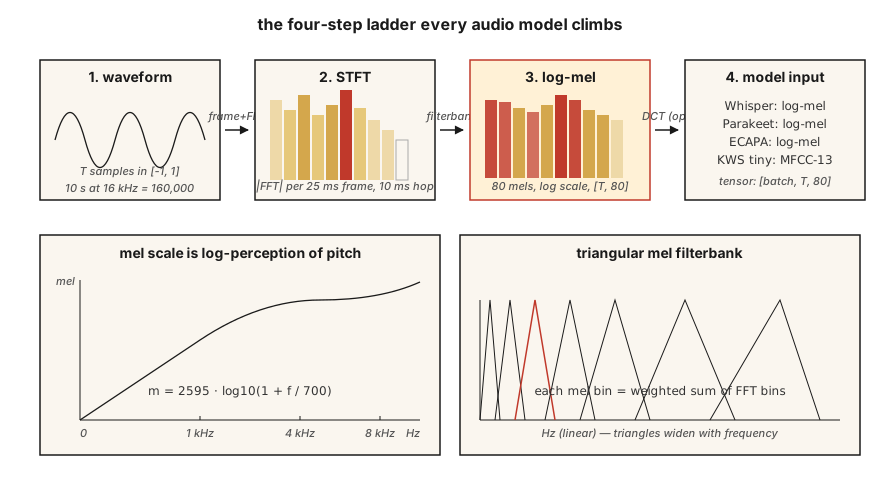
STFT (Short-Time Fourier Transform). Slice the waveform into overlapping frames (typical: 25 ms window, 10 ms hop = 400 samples / 160 samples at 16 kHz). Multiply each frame by a window function (Hann is the default; Hamming slightly different tradeoff). FFT each frame. Stack the magnitude spectra into a matrix of shape (n_frames, n_freq_bins). That is your spectrogram.
Log-magnitude. Raw magnitudes span 5-6 orders of magnitude. Take log(|X| + 1e-6) or 20 * log10(|X|) to compress dynamic range. Every production pipeline uses log-magnitude, not raw magnitude.
Mel scale. Frequency f in Hz maps to mel m by m = 2595 \cdot \log_{10}(1 + f / 700). The mapping is roughly linear below 1 kHz and roughly logarithmic above. 80 mel bins covering 0–8 kHz is the standard ASR input.
Mel filterbank. A set of triangular filters spaced equally on the mel scale. Each filter is a weighted sum of adjacent FFT bins. Multiplying the STFT magnitude by the filterbank matrix gives the mel spectrogram in one matmul.
Log-mel spectrogram. log(mel_spec + 1e-10). Whisper's input. Parakeet's input. SeamlessM4T's input. The universal 2026 audio frontend.
MFCCs. Take the log-mel spectrogram, apply a DCT (type II), keep the first 13 coefficients. Decorrelates the features and compresses further. Dominant feature until about 2015 when CNNs/Transformers on raw log-mels caught up. Still used in speaker recognition (x-vectors, ECAPA).
Resolution trade. Larger FFT = better frequency resolution but worse time resolution. 25 ms / 10 ms is the audio-ML default; 50 ms / 12.5 ms for music; 5 ms / 2 ms for transient detection (drum hits, plosives).
Build It
Step 1: frame the waveform
pythondef frame(signal, frame_len, hop):
n = 1 + (len(signal) - frame_len) // hop
return [signal[i * hop : i * hop + frame_len] for i in range(n)]A 10-second 16 kHz clip with frame_len=400, hop=160 yields 998 frames.
Step 2: Hann window
pythonimport math
def hann(N):
return [0.5 * (1 - math.cos(2 * math.pi * n / (N - 1))) for n in range(N)]Multiply element-wise before the FFT. Removes spectral leakage caused by truncating at non-zero endpoints.
Step 3: STFT magnitude
pythondef stft_magnitude(signal, frame_len=400, hop=160):
win = hann(frame_len)
frames = frame(signal, frame_len, hop)
return [magnitudes(dft([w * s for w, s in zip(win, f)])) for f in frames]Production uses torch.stft or librosa.stft (FFT-backed, vectorized). The loop here is pedagogical; it runs on short clips in code/main.py.
Step 4: mel filterbank
pythondef hz_to_mel(f):
return 2595.0 * math.log10(1.0 + f / 700.0)
def mel_to_hz(m):
return 700.0 * (10 ** (m / 2595.0) - 1)
def mel_filterbank(n_mels, n_fft, sr, fmin=0, fmax=None):
fmax = fmax or sr / 2
mels = [hz_to_mel(fmin) + (hz_to_mel(fmax) - hz_to_mel(fmin)) * i / (n_mels + 1)
for i in range(n_mels + 2)]
hzs = [mel_to_hz(m) for m in mels]
bins = [int(h * n_fft / sr) for h in hzs]
fb = [[0.0] * (n_fft // 2 + 1) for _ in range(n_mels)]
for m in range(n_mels):
for k in range(bins[m], bins[m + 1]):
fb[m][k] = (k - bins[m]) / max(1, bins[m + 1] - bins[m])
for k in range(bins[m + 1], bins[m + 2]):
fb[m][k] = (bins[m + 2] - k) / max(1, bins[m + 2] - bins[m + 1])
return fb80 mels covering 0–8 kHz with n_fft=400 gives an (80, 201) matrix. Multiply the (n_frames, 201) STFT magnitude by the transpose to get (n_frames, 80) mel spectrogram.
Step 5: log-mel
pythondef log_mel(mel_spec, eps=1e-10):
return [[math.log(max(v, eps)) for v in frame] for frame in mel_spec]Common alternatives: librosa.power_to_db (reference-normalized dB), 10 * log10(power + eps). Whisper uses a more involved clip + normalize routine (see Whisper's log_mel_spectrogram).
Step 6: MFCCs
pythondef dct_ii(x, n_coeffs):
N = len(x)
return [
sum(x[n] * math.cos(math.pi * k * (2 * n + 1) / (2 * N)) for n in range(N))
for k in range(n_coeffs)
]Apply DCT to each log-mel frame, keep the first 13 coefficients. That is your MFCC matrix. The first coefficient is usually dropped (it encodes overall energy).
Use It
The 2026 stack:
| Task | Features |
|---|---|
| ASR (Whisper, Parakeet, SeamlessM4T) | 80 log-mels, 10 ms hop, 25 ms window |
| TTS acoustic model (VITS, F5-TTS, Kokoro) | 80 mels, 5–12 ms hop for fine temporal control |
| Audio classification (AST, PANNs, BEATs) | 128 log-mels, 10 ms hop |
| Speaker embedding (ECAPA-TDNN, WavLM) | 80 log-mels or raw-waveform SSL |
| Music (MusicGen, Stable Audio 2) | EnCodec discrete tokens (not mels) |
| Keyword spotting | 40 MFCCs for tiny devices |
Rule of thumb: if you are not working on music, start with 80 log-mels. The burden of proof is on any deviation.
Pitfalls that still ship in 2026
- Mel count mismatch. Training with 80 mels, inference with 128 mels. Silent failure. Log the feature shape at both ends.
- Sample-rate mismatch upstream. Mels computed at 22.05 kHz look different from 16 kHz. Fix SR before featurization.
- dB vs log. Whisper expects log-mel, not dB-mel. Some HF pipelines autodetect; your custom code will not.
- Normalization drift. Per-utterance normalization during training, global normalization during inference. Production bug that doubles WER.
- Leakage from padding. Zero-padding the end of a clip produces a flat spectrum in the trailing frames. Pad symmetrically or replicate.
Ship It
Save as outputs/skill-feature-extractor.md. The skill picks feature type, mel count, frame/hop, and normalization for a given model target.
Exercises
- Easy. Run
code/main.py. It synthesizes a chirp (frequency swept 200 → 4000 Hz) and prints the argmax mel bin per frame. Plot (optional) and confirm it matches the sweep. - Medium. Re-run with
n_melsin{40, 80, 128}andframe_lenin{200, 400, 800}. Measure sharp-peak bandwidth across the time axis. Which combo resolves the chirp the best? - Hard. Implement
power_to_dband compare ASR accuracy of a tiny CNN classifier on AudioMNIST using (a) raw log-mel, (b) dB-mel withref=max, (c) MFCC-13 + delta + delta-delta. Report top-1 accuracy.
Key Terms
| Term | What people say | What it actually means |
|---|---|---|
| Frame | A slice | 25 ms chunk of waveform fed to one FFT. |
| Hop | Stride | Samples between consecutive frames; 10 ms is ASR default. |
| Window | Hann/Hamming thing | Point-wise multiplier that tapers the frame edges to zero. |
| STFT | Spectrogram generator | Framed + windowed FFT; yields time × frequency matrix. |
| Mel | Warped frequency | Log-perception scale; m = 2595·log10(1 + f/700). |
| Filterbank | The matrix | Triangular filters that project STFT onto mel bins. |
| Log-mel | Whisper's input | log(mel_spec + eps); standardized in 2026. |
| MFCC | Old-school feature | DCT of log-mel; 13 coeffs, decorrelated. |
Further Reading
- Davis, Mermelstein (1980). Comparison of parametric representations for monosyllabic word recognition — the MFCC paper.
- Stevens, Volkmann, Newman (1937). A Scale for the Measurement of the Psychological Magnitude Pitch — the original mel scale.
- OpenAI — Whisper source, log_mel_spectrogram — read the reference implementation.
- librosa feature extraction docs — reference for
mfcc,melspectrogram, and hop/window. - NVIDIA NeMo — audio preprocessing — production-scale pipeline for Parakeet + Canary models.
Diagrams1 figure