- Name the five-axis VLM design space: image encoder, connector, LLM, data mix, resolution schedule.
- Read an MM1 / Idefics2 / Cambrian-1 ablation table and predict which knob moves a given benchmark.
- Pick a recipe (encoder, connector, data, resolution) for a new VLM given a compute budget and task mix.
- Explain why detailed human captions beat GPT-4V distillation at the same token count.
The Problem
Hundreds of open-weight VLMs exist. Most of the gap between "good" and "state-of-the-art" is not architecture. It is data, resolution schedule, and encoder choice. Knowing which knob to turn first when your model underperforms saves you a 5-million-GPU-hour mistake.
The 2023 wave (LLaVA-1.5, InstructBLIP, MiniGPT-4) ran on caption-pair pretraining + LLaVA-Instruct-150k. Good baseline. Topped out around MMMU 35%.
The 2024 wave (MM1, Idefics2, Molmo, Cambrian-1, Prismatic VLMs) ran exhaustive ablations. Results were surprising and practical.
The Concept
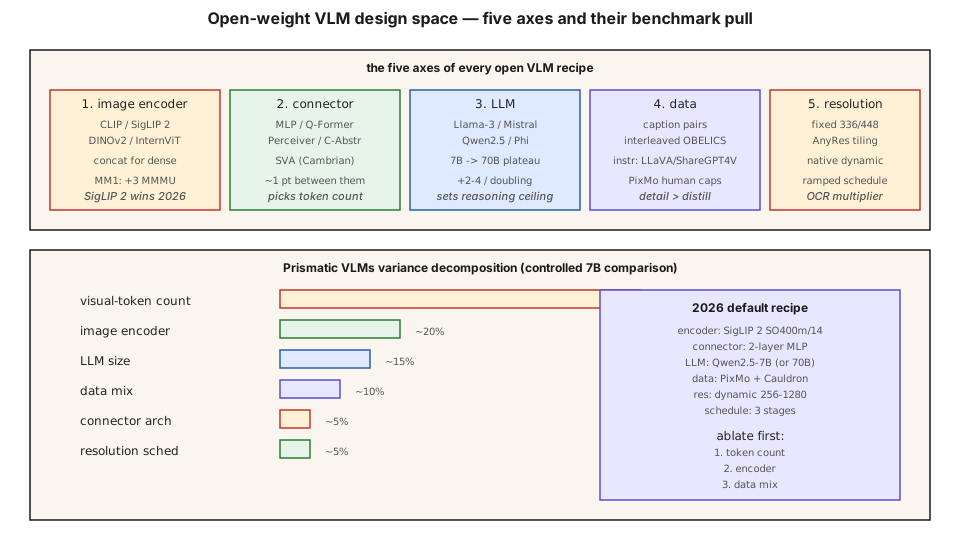
The five-axis design space
Idefics2 (Laurençon et al., 2024) named the axes:
- Image encoder. CLIP ViT-L/14, SigLIP SO400m/14, DINOv2 ViT-g/14, InternViT-6B. Encoders differ in patch size, resolution, and pretraining objective.
- Connector. MLP (2-4 layers), Q-Former (32 queries + cross-attn), Perceiver Resampler (64 queries), C-Abstractor (convolutional + bilinear pooling).
- Language model. Llama-3 8B / 70B, Mistral 7B, Phi-3, Gemma-2, Qwen2.5. LLM size is the dominant param cost.
- Training data. Caption pairs (CC3M, LAION), interleaved (OBELICS, MMC4), instruction (LLaVA-Instruct, ShareGPT4V, PixMo, Cauldron).
- Resolution schedule. Fixed 224/336/448, AnyRes, native dynamic. Ramped during training or constant.
Every production VLM makes a choice on each axis. Most of the variance in MMMU scores is explained by axes 1, 4, and 5 — not by which connector you picked.
Axis 1: encoder > connector
MM1 Section 3.2 showed: swapping from CLIP ViT-L/14 to SigLIP SO400m/14 added 3+ points MMMU. Swapping the connector from MLP to Perceiver Resampler added less than 1 point. Idefics2 replicated: SigLIP > CLIP, Q-Former ≈ MLP ≈ Perceiver at the same token count.
Cambrian-1's "Cambrian Vision Encoders Match-Up" (Tong et al., 2024) ran 20+ encoders on a vision-centric benchmark (CV-Bench). The top of the leaderboard is a mix of DINOv2 and SigLIP; CLIP is middle of the pack; ImageBind and ViT-MAE are lower. The gap from CLIP ViT-L to DINOv2 ViT-g/14 is ~5-7 points on CV-Bench.
The 2026 default encoder for open VLMs is SigLIP 2 SO400m/14 for semantic + dense features, sometimes concatenated with DINOv2 ViT-g/14 features (Cambrian's "Spatial Vision Aggregator" does this).
Axis 2: connector design is a wash
MM1, Idefics2, Prismatic, and MM-Interleaved all reached the same conclusion: at a fixed visual-token count, connector architecture barely matters. A 2-layer MLP on mean-pooled patches performs within 1 point of a 32-query Q-Former at the same token budget.
What does matter is the token count. More visual tokens = more LLM compute = better performance up to a point, then diminishing returns. 64 tokens per image is too few for OCR. 576-1024 tokens is the sweet spot for most open VLMs. 2048+ helps only for documents and charts.
Q-Former vs MLP is a cost question, not a quality question: Q-Former caps tokens at 32-64 regardless of image resolution; MLP emits all patch tokens. For high-res inputs, Q-Former saves LLM context; for low-res, the difference is noise.
Axis 3: LLM size sets the ceiling
Doubling the LLM from 7B to 13B reliably adds 2-4 points on MMMU across every VLM paper. At 70B you saturate most benchmarks. The VLM's multimodal reasoning ceiling is the LLM's text reasoning ceiling — the visual encoder can only feed it, not reason for it.
This is why Qwen2.5-VL-72B and Claude Opus 4.7 crush MMMU-Pro and ScreenSpot-Pro: the language brain is huge. A 7B VLM cannot substitute for a 70B VLM through clever connector design.
Axis 4: data — detailed human captions beat distillation
Molmo + PixMo (Deitke et al., 2024) is the 2024 result everyone should read. Allen AI had human annotators describe images in 1-3 minute dense speech-to-text passes, yielding 712K densely-captioned images. No GPT-4V distillation anywhere in the training data.
Molmo-72B beat Llama-3.2-90B-Vision on 11 of 11 benchmarks. The delta is not architecture — it is caption quality. Detailed human captions contain 5-10x more information per image than short web captions and stay factually grounded where GPT-4V distillation hallucinates.
ShareGPT4V (Chen et al., 2023) and Cauldron (Idefics2) followed the same playbook with mixed human + GPT-4V captions. The trend is clear: for the 2026 frontier, caption density > caption quantity > distillation convenience.
Axis 5: resolution and its schedule
Idefics2's ablations: 384 -> 448 adds 1-2 points. 448 -> 980 with image splitting (AnyRes) adds another 3-5 on OCR benchmarks. Flat resolution training plateaus at medium accuracy; resolution ramping (start 224, finish 448 or native) trains faster and ends higher.
Cambrian-1 ran a resolution vs tokens trade-off: at fixed compute, you can have more tokens at lower resolution or fewer tokens at higher resolution. Higher resolution wins for OCR; lower-res-more-tokens wins for general scene understanding.
The 2026 production recipe: train Stage 1 at 384 fixed, Stage 2 with dynamic resolution up to 1280 for OCR-heavy tasks.
The Prismatic controlled comparison
Prismatic VLMs (Karamcheti et al., 2024) is the paper that controlled all the axes. Same 13B LLM, same instruction data, same evaluation — only one axis varies at a time. Results:
- Per-image visual-token count explains ~60% of variance.
- Encoder choice explains ~20%.
- Connector architecture explains ~5%.
- Everything else (data mix, scheduler, LR) the remaining ~15%.
This is a rough decomposition, but it is the cleanest answer to "what should I ablate first" in the literature.
A picker for 2026
Given the evidence, the default open-VLM recipe for a new project in 2026:
- Encoder: SigLIP 2 SO400m/14 at native resolution with NaFlex, concatenated with DINOv2 ViT-g/14 for dense features if you need segmentation/grounding.
- Connector: 2-layer MLP on patch tokens. Skip Q-Former unless you are token-constrained.
- LLM: Qwen2.5 / Llama-3.1 / Gemma 2, 7B for cost, 70B for quality, picked by target latency.
- Data: PixMo + ShareGPT4V + Cauldron, topped up with task-specific instruction data.
- Resolution: dynamic (min 256, max 1280 pixels per long side).
- Schedule: Stage 1 alignment (projector-only), Stage 2 full fine-tune, Stage 3 task-specific fine-tune.
Every one of those defaults traces back to a measured ablation in the papers cited at the end of this lesson.
Use It
code/main.py is an ablation table parser and recipe picker. It encodes the MM1 and Idefics2 ablation tables (condensed) and lets you query:
- "Given budget X and task Y, what recipe wins?"
- "If I swap SigLIP for CLIP on a 7B Llama, what is the expected MMMU delta?"
- "Which axis should I ablate first for an 80% confidence answer?"
The output is a ranked recipe list with expected benchmark deltas and an "ablate first" recommendation.
Ship It
This lesson produces outputs/skill-vlm-recipe-picker.md. Given a target task mix, a compute budget, and a latency target, it emits a full recipe (encoder, connector, LLM, data mix, resolution schedule) with citations to the ablation that justifies each choice. Stops engineers from reinventing the Idefics2 ablation table every time a new VLM project starts.
Exercises
- Read MM1 Section 3.2. For a fixed 2B LLM at budget 50M images, which encoder wins? Would the answer flip at 13B LLM? Why?
- Cambrian-1 finds that concatenating DINOv2 + SigLIP outperforms either alone on vision-centric benchmarks but adds no signal on MMMU. Predict which benchmarks gain and which stay flat.
- Your target is a mobile UI agent on a 2B LLM. Pick encoder, connector, resolution, and data mix. Justify each choice with a specific ablation table.
- Molmo ships 4B and 72B models. The 4B is competitive with closed 7B VLMs; the 72B beats Llama-3.2-90B-Vision on 11/11 benchmarks. What does that tell you about the LLM-size plateau hypothesis?
- Design an ablation table to isolate data-mix quality from encoder quality on a 7B VLM. How many training runs minimum? Propose the four axis settings.
Key Terms
| Term | What people say | What it actually means |
|---|---|---|
| Ablation | "Turning one knob" | Training multiple runs that differ in exactly one design-space axis, holding everything else constant |
| Connector | "Bridge" / "projector" | Trainable module that maps vision encoder output into the LLM's token space (MLP, Q-Former, Perceiver) |
| Detailed human caption | "Dense caption" | A multi-sentence human-written description (typically 80-300 tokens) richer than a web alt text |
| Distillation | "GPT-4V captions" | Training data generated by a stronger proprietary VLM; convenient but prone to inherited hallucination |
| AnyRes / dynamic res | "High-res path" | Strategy to feed images larger than the encoder's native resolution via tiling or M-RoPE |
| Resolution ramp | "Curriculum" | Training schedule that starts low-resolution and increases, speeding alignment learning |
| Vision-centric bench | "CV-Bench / BLINK" | Evaluation that stresses fine-grained visual perception rather than language-heavy reasoning |
| PixMo | "Molmo's data" | Allen AI's 712K densely-captioned image dataset; human speech transcribed into dense captions |
Further Reading
- McKinzie et al. — MM1 (arXiv:2403.09611)
- Laurençon et al. — Idefics2 / What matters building VLMs (arXiv:2405.02246)
- Deitke et al. — Molmo and PixMo (arXiv:2409.17146)
- Tong et al. — Cambrian-1 (arXiv:2406.16860)
- Karamcheti et al. — Prismatic VLMs (arXiv:2402.07865)
Diagrams1 figure