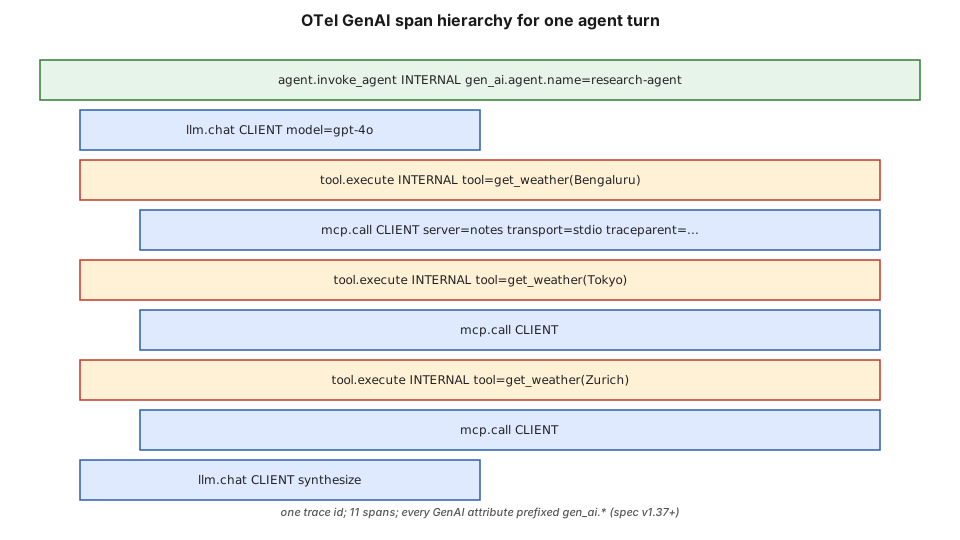
- Name the required OTel GenAI attributes for an LLM span and a tool-execution span.
- Build a trace hierarchy that covers agent loop, LLM call, tool call, and MCP client dispatch.
- Decide what content to capture (opt-in) vs redact (defaults).
- Emit spans to a local collector (Jaeger, Langfuse) without rewriting tool code.
The Problem
A debug from February 2026: user reports "my agent sometimes takes 30 seconds to respond; other times 3 seconds." No traces. Logs show the LLM call, but not the tool dispatch, not the MCP server round-trip, not the sub-agent. You guess. Eventually you find: one MCP server occasionally hangs on a cold-start.
Without end-to-end tracing, you cannot find this. OTel GenAI fixes it.
The conventions settled in 2025-2026 under the OpenTelemetry semantic-conventions group. They define stable attribute names so Datadog, Langfuse, Phoenix, OpenLLMetry, and AgentOps all parse the same spans. Instrument once; ship to any backend.
The Concept
Span hierarchy
agent.invoke_agent (top, INTERNAL span)
├── llm.chat (CLIENT span)
├── tool.execute (INTERNAL)
│ └── mcp.call (CLIENT span)
├── llm.chat (CLIENT span)
└── subagent.invoke (INTERNAL)The whole thing nests under one trace id. Span ids link the parent-child relationships.
Required attributes
Per the 2025-2026 semconv:
gen_ai.operation.name—"chat","text_completion","embeddings","execute_tool","invoke_agent".gen_ai.provider.name—"openai","anthropic","google","azure_openai".gen_ai.request.model— requested model string (e.g."gpt-4o-2024-08-06").gen_ai.response.model— the model actually served.gen_ai.usage.input_tokens/gen_ai.usage.output_tokens.gen_ai.response.id— provider response id for correlation.
For tool spans:
gen_ai.tool.name— tool identifier.gen_ai.tool.call.id— the specific call id.gen_ai.tool.description— tool description (optional).
For agent spans:
gen_ai.agent.name/gen_ai.agent.id/gen_ai.agent.description.
Span kinds
SpanKind.CLIENTfor calls crossing a process boundary (LLM provider, MCP server).SpanKind.INTERNALfor the agent's own loop steps and tool execution.
Opt-in content capture
By default, spans carry metrics and timing — not prompts or completions. Large payloads and PII are off by default. Set OTEL_SEMCONV_STABILITY_OPT_IN=gen_ai_latest_experimental and specific content-capture env vars to include content. Review carefully before enabling in prod.
Events on spans
Token-level events can be added as span events:
gen_ai.content.prompt— input messages.gen_ai.content.completion— output messages.gen_ai.content.tool_call— tool call as recorded.
Events time-order within a span for detailed replay.
Exporters
OTel spans export to:
- Jaeger / Tempo. OSS, on-prem.
- Langfuse. LLM-observability-specific; visualizes token usage.
- Arize Phoenix. Evals + tracing combined.
- Datadog. Commercial; natively parses
gen_ai.*attributes. - Honeycomb. Column-oriented; query-friendly.
All speak OTLP, the wire format. Your code does not care.
Propagation across MCP
When an MCP client calls a server, inject the W3C traceparent header into the request. Streamable HTTP supports standard headers. Stdio does not carry HTTP headers natively; the spec's 2026 roadmap discusses adding a _meta.traceparent field on JSON-RPC calls.
Until that ships: include the traceparent in the _meta of every request manually. Server logs the trace id.
Metrics
Alongside spans, the GenAI semconv defines metrics:
gen_ai.client.token.usage— histogram.gen_ai.client.operation.duration— histogram.gen_ai.tool.execution.duration— histogram.
Use these for dashboards that do not need per-call detail.
AgentOps layer
AgentOps (founded 2024) specializes in GenAI observability. It wraps popular frameworks (LangGraph, Pydantic AI, CrewAI) to emit OTel spans automatically. Useful if your stack uses a supported framework; use manual instrumentation otherwise.
Use It
code/main.py emits OTel-shaped spans to stdout (in OTLP-JSON-like format) for an agent that calls an LLM, dispatches two tools, and makes one MCP round-trip. No real exporter — the lesson focuses on the span shape and attribute set. Paste the output into an OTLP-compatible viewer or just read it.
What to look at:
- Trace id is shared across all spans.
- Parent-child links are encoded via
parentSpanId. - Required
gen_ai.*attributes are populated. - Content capture is off by default; one scenario turns it on via env var.
Ship It
This lesson produces outputs/skill-otel-genai-instrumentation.md. Given an agent codebase, the skill produces an instrumentation plan: where to add spans, which attributes to populate, and which exporters to target.
Exercises
- Run
code/main.py. Count the spans and identify which is CLIENT vs INTERNAL.
- Turn on content capture (env var) and confirm
gen_ai.content.promptandgen_ai.content.completionevents appear. Note the implications for PII.
- Add the tool-execution metric
gen_ai.tool.execution.durationand emit it as a histogram sample per call.
- Propagate a traceparent from a parent agent span into an MCP request's
_meta.traceparentfield. Verify the MCP server would see the same trace id.
- Read the OTel GenAI semconv spec. Identify one attribute listed in the semconv that this lesson's code does NOT emit. Add it.
Key Terms
| Term | What people say | What it actually means |
|---|---|---|
| OTel | "OpenTelemetry" | Open standard for traces, metrics, logs |
| GenAI semconv | "GenAI semantic conventions" | Stable attribute names for LLM / tool / agent spans |
gen_ai.* | "The attribute namespace" | All GenAI attributes share this prefix |
| Span | "Timed operation" | A unit of work with a start, end, and attributes |
| Trace | "Cross-span ancestry" | Tree of spans sharing a trace id |
| SpanKind | "CLIENT / SERVER / INTERNAL" | Hints about span direction |
| OTLP | "OpenTelemetry Line Protocol" | Wire format for exporters |
| Opt-in content | "Prompt / completion capture" | Off by default; env var to enable |
| traceparent | "W3C header" | Propagates trace context across services |
| Exporter | "Backend-specific shipper" | Component that sends spans to Jaeger / Datadog / etc. |
Further Reading
- OpenTelemetry — GenAI semconv — canonical conventions for GenAI spans, metrics, and events
- OpenTelemetry — GenAI spans — LLM and tool-execution span attribute list
- OpenTelemetry — GenAI agent spans — agent-level
invoke_agentspan - open-telemetry/semantic-conventions — GenAI spans — GitHub-hosted source of truth
- Datadog — LLM OTel semantic convention — production integration walkthrough
Diagrams1 figure