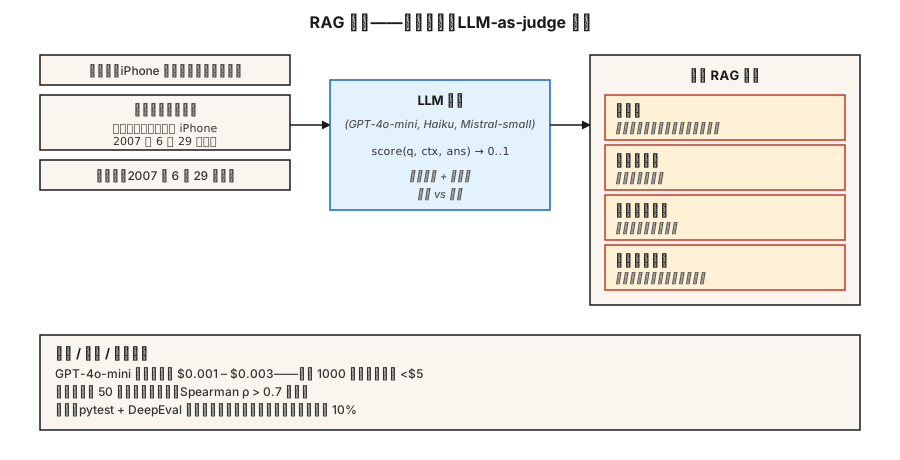
问题
你的 RAG 系统回答:「June 29th, 2007。」
标准答案(gold reference)是:「June 29, 2007。」
精确匹配(Exact Match)得 0 分,F1 约 75%,而人工评分会给 100%。
现在把这个场景乘以 10,000 个测试用例,再乘以检索器、分块、prompt 或模型的每一次变更。你需要一个评估器:理解语义、能低成本大规模运行、不会在回归问题上撒谎,并且能暴露正确的失败模式。
2026 年有三个框架专门解决这个问题。
- RAGAS。 Retrieval-Augmented Generation ASsessment。提供四个 RAG 指标(faithfulness、answer-relevance、context-precision、context-recall),后端是 NLI + LLM 评判。有研究支撑,轻量。
- DeepEval。 面向 LLM 的 Pytest。提供 G-Eval、任务完成度、幻觉、偏差等指标,原生适配 CI/CD。
- G-Eval。 一种方法(也是 DeepEval 的一个指标):带思维链的 LLM-as-judge,自定义评判标准,输出 0-1 分。
三者都依赖 LLM-as-judge。本课帮你建立对该方法的直觉,以及围绕它的信任层。
概念
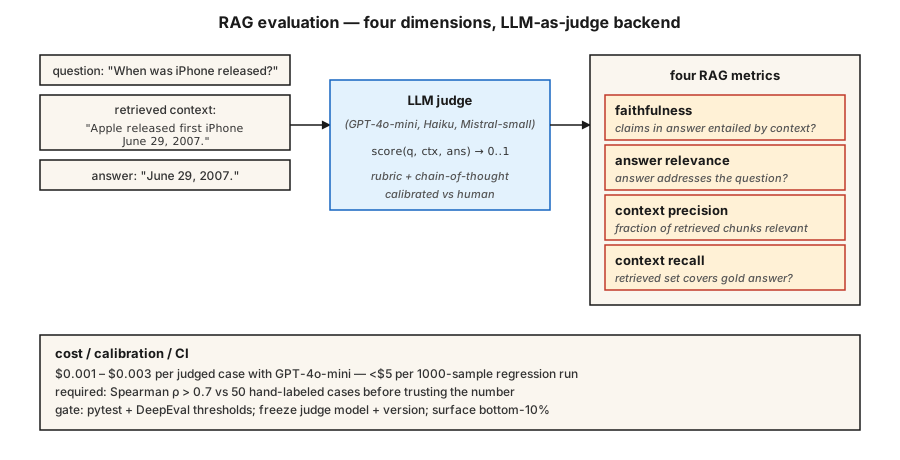
LLM-as-judge(LLM 评判)。 用一个 LLM 按评分标准(rubric)给输出打分,替代静态指标。给定 (query, context, answer),提示评判 LLM:「在 faithfulness 上打 0-1 分。」然后取回分数。
为什么有效:LLM 能以极低的成本近似人类判断。GPT-4o-mini 每个评分样本约 $0.003,1000 个样本的回归评估不到 $5。
为什么它会悄悄失效:
- 评判偏差。 评判模型偏好更长的答案、自己模型家族的答案,以及与 prompt 风格一致的答案。
- JSON 解析失败。 坏 JSON → NaN 分数 → 被静默排除在聚合之外。用过 RAGAS 的人都懂这种痛。用 try/except 加显式失败模式来设门槛。
- 模型版本漂移。 升级评判模型就会改变每一项指标。冻结评判模型及其版本。
RAG 四指标。
| 指标 | 回答的问题 | 后端 |
|---|---|---|
| Faithfulness | 答案中的每个论断都来自检索到的上下文吗? | 基于 NLI 的蕴含判断 |
| Answer relevance | 答案回应了问题吗? | 从答案生成假设问题,与真实问题比较 |
| Context precision | 检索到的分块中有多大比例是相关的? | LLM 评判 |
| Context recall | 检索是否返回了所有需要的内容? | 对照标准答案做 LLM 评判 |
G-Eval。 定义自定义标准:「答案是否引用了正确的来源?」框架会自动把它展开成思维链式的评估步骤,然后打出 0-1 分。适合 RAGAS 未覆盖的领域特定质量维度。
校准。 在算出与人工标注的相关性之前,永远不要相信评判的原始分数。跑 100 个手工标注的样本,画出评判分数 vs 人工分数,计算 Spearman rho。如果 rho < 0.7,你的评判标准需要改进。
构建它
步骤 1:用 NLI 计算忠实度(RAGAS 风格)
pythonfrom typing import Callable
from transformers import pipeline
nli = pipeline("text-classification",
model="MoritzLaurer/DeBERTa-v3-large-mnli-fever-anli-ling-wanli",
top_k=None)
# `llm` is any callable: prompt str -> generated str.
# Example: llm = lambda p: client.messages.create(model="claude-haiku-4-5", ...).content[0].text
LLM = Callable[[str], str]
def atomic_claims(answer: str, llm: LLM) -> list[str]:
prompt = f"""Break this answer into simple factual claims (one per line):
{answer}
"""
return llm(prompt).splitlines()
def faithfulness(answer: str, context: str, llm: LLM) -> float:
claims = atomic_claims(answer, llm)
if not claims:
return 0.0
supported = 0
for claim in claims:
result = nli({"text": context, "text_pair": claim})[0]
entail = next((s for s in result if s["label"] == "entailment"), None)
if entail and entail["score"] > 0.5:
supported += 1
return supported / len(claims)把答案分解成原子论断,用 NLI 逐条对照检索到的上下文检查。忠实度 = 被支持的论断占比。
步骤 2:答案相关性
pythonimport numpy as np
from sentence_transformers import SentenceTransformer
# encoder: any model implementing .encode(texts, normalize_embeddings=True) -> ndarray
# e.g., encoder = SentenceTransformer("BAAI/bge-small-en-v1.5")
def answer_relevance(question: str, answer: str, encoder, llm: LLM, n: int = 3) -> float:
prompt = f"Write {n} questions this answer could be the answer to:\n{answer}"
generated = [line for line in llm(prompt).splitlines() if line.strip()][:n]
if not generated:
return 0.0
q_emb = np.asarray(encoder.encode([question], normalize_embeddings=True)[0])
g_embs = np.asarray(encoder.encode(generated, normalize_embeddings=True))
sims = [float(q_emb @ g_emb) for g_emb in g_embs]
return sum(sims) / len(sims)如果答案隐含的问题与用户所问不同,相关性就会下降。
步骤 3:G-Eval 自定义指标
pythonfrom deepeval.metrics import GEval
from deepeval.test_case import LLMTestCaseParams, LLMTestCase
metric = GEval(
name="Correctness",
criteria="The answer should be factually accurate and match the expected output.",
evaluation_steps=[
"Read the expected output.",
"Read the actual output.",
"List factual claims in the actual output.",
"For each claim, mark supported or unsupported by the expected output.",
"Return score = fraction supported.",
],
evaluation_params=[LLMTestCaseParams.INPUT, LLMTestCaseParams.ACTUAL_OUTPUT, LLMTestCaseParams.EXPECTED_OUTPUT],
)
test = LLMTestCase(input="When was the first iPhone released?",
actual_output="June 29th, 2007.",
expected_output="June 29, 2007.")
metric.measure(test)
print(metric.score, metric.reason)评估步骤就是评分标准。显式步骤比隐式「打 0-1 分」的 prompt 更稳定。
步骤 4:CI 门禁
pythonimport deepeval
from deepeval.metrics import FaithfulnessMetric, ContextualRelevancyMetric
def test_rag_system():
cases = load_regression_cases()
faith = FaithfulnessMetric(threshold=0.85)
rel = ContextualRelevancyMetric(threshold=0.7)
for case in cases:
faith.measure(case)
assert faith.score >= 0.85, f"faithfulness regression on {case.id}"
rel.measure(case)
assert rel.score >= 0.7, f"relevancy regression on {case.id}"以 pytest 文件形式交付,每个 PR 都运行,出现回归就阻止合并。
步骤 5:从零实现的玩具评估
见 code/main.py。仅用标准库近似实现忠实度(答案论断与上下文的重叠)和相关性(答案 token 与问题 token 的重叠)。不能用于生产,只用来展示形态。
常见陷阱
- 没有校准。 与人工标注相关性只有 0.3 的评判就是噪声。上线前必须做一轮校准。
- 自评。 用同一个 LLM 既生成又评判,会把分数抬高 10-20%。评判要换一个模型家族。
- 成对评判中的位置偏差。 评判模型偏好先出现的选项。务必随机化顺序,并交换双方各跑一次。
- 原始聚合隐藏失败。 平均分 0.85 常常掩盖 5% 的灾难性失败。一定要检查最低分位。
- 黄金数据集腐化。 没有版本、随时间漂移的评估集会破坏纵向对比。每次变更都给数据集打标签。
- LLM 成本。 规模上去后,评判调用主导成本。用满足校准阈值的最便宜模型:GPT-4o-mini、Claude Haiku、Mistral-small。
使用它
2026 年的技术栈:
| 用例 | 框架 |
|---|---|
| RAG 质量监控 | RAGAS(4 个指标) |
| CI/CD 回归门禁 | DeepEval + pytest |
| 自定义领域标准 | DeepEval 中的 G-Eval |
| 在线实时流量监控 | RAGAS 的无参考答案模式 |
| 人工在环抽查 | LangSmith 或 Phoenix 加标注界面 |
| 红队测试 / 安全评估 | Promptfoo + DeepEval |
典型组合:RAGAS 做监控,DeepEval 做 CI,G-Eval 做新维度。三者都跑;它们的分歧很有价值。
交付它
保存为 outputs/skill-eval-architect.md:
markdown---
name: eval-architect
description: Design an LLM evaluation plan with calibrated judge and CI gates.
version: 1.0.0
phase: 5
lesson: 27
tags: [nlp, evaluation, rag]
---
Given a use case (RAG / agent / generative task), output:
1. Metrics. Faithfulness / relevance / context-precision / context-recall + any custom G-Eval metrics with criteria.
2. Judge model. Named model + version, rationale for cost vs accuracy.
3. Calibration. Hand-labeled set size, target Spearman rho vs human > 0.7.
4. Dataset versioning. Tag strategy, change log, stratification.
5. CI gate. Thresholds per metric, regression-window logic, bottom-quantile alert.
Refuse to rely on a judge untested against ≥50 human-labeled examples. Refuse self-evaluation (same model generates + judges). Refuse aggregate-only reporting without bottom-10% surfacing. Flag any pipeline where judge upgrade lands without parallel baseline eval.练习
- 简单。 在 10 个已知存在幻觉的 RAG 例子上使用 RAGAS,验证 faithfulness 指标能抓到每一个。
- 中等。 人工为 50 个 QA 答案的正确性打 0-1 分,用 G-Eval 评分,计算评判与人工之间的 Spearman rho。
- 困难。 用 DeepEval 搭建 pytest CI 门禁。故意让检索器退化,验证门禁失败。再加上对最低 10% 分位的阈值检查告警。
关键术语
| 术语 | 常见的说法 | 实际含义 |
|---|---|---|
| LLM-as-judge | 用 LLM 打分 | 提示评判模型按评分标准给输出打 0-1 分。 |
| RAGAS | RAG 指标库 | 开源评估框架,提供 4 个无参考 RAG 指标。 |
| Faithfulness | 答案有依据吗? | 答案论断中被检索上下文蕴含的比例。 |
| Context precision | 检索到的分块相关吗? | top-K 分块中真正有用的比例。 |
| Context recall | 检索找全了吗? | 标准答案论断中被检索分块支持的比例。 |
| G-Eval | 自定义 LLM 评判 | 评分标准 + 思维链评估步骤 + 0-1 分。 |
| 校准 | 信任但验证 | 评判分数与人工分数的 Spearman 相关性。 |
延伸阅读
- Es et al. (2023). RAGAS: Automated Evaluation of Retrieval Augmented Generation —— RAGAS 论文。
- Liu et al. (2023). G-Eval: NLG Evaluation using GPT-4 with Better Human Alignment —— G-Eval 论文。
- DeepEval docs —— 开源生产级技术栈。
- Zheng et al. (2023). Judging LLM-as-a-Judge with MT-Bench and Chatbot Arena —— 偏差、校准与局限。
- MLflow GenAI Scorer —— 集成 RAGAS、DeepEval、Phoenix 的统一框架。
示意图共 1 张